The X
Someone had gone over the Deer Mountain trail in pink highlighter.
And near the spot where Toni Henthorn fell, far from any marked path, somebody had drawn an X.
“He seemed at a loss for words,” Faherty told the jury. “He hemmed and hawed before he finally gave me an explanation.” Harold denied using the map on the hike and said he was not sure why it was marked.
The last-minute change of plan had never been last-minute. Harold had told an acquaintance that he took six different hikes in the park in the weeks before the trip, trying to find the right one for their anniversary. He told her he had planned every minute of it. Prosecutors put the number of scouting trips at nine.
Special Agent Beth Shott of the National Park Service’s Investigative Services Branch, the park system’s own version of the FBI, walked the route herself. She pushed through stumpy pines until the trail vanished behind her. She climbed down a chute of loose rock to the little stone platform at the edge. She compared it to a crow’s nest.
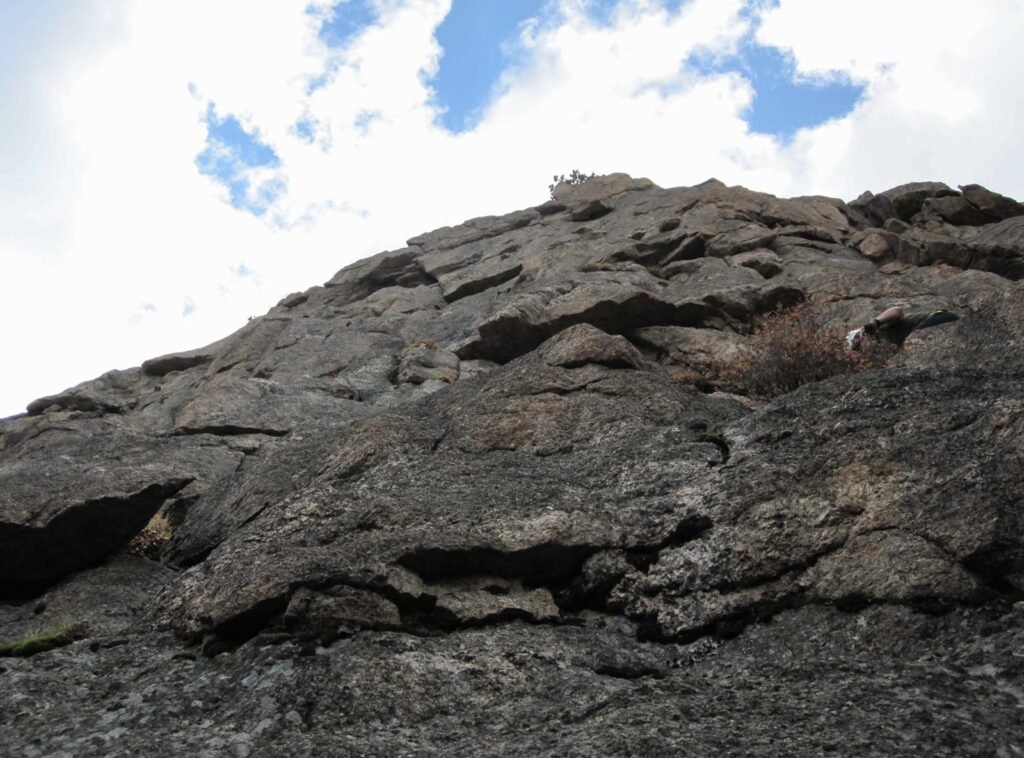
Toni had bad knees. Friends said she was more of a walker than a hiker. She would not have gone there on her own, and nobody would stumble on it by accident. Rangers told the jury the spot was obscure, with no trail leading to it.
Shott made up her mind on that first climb. Toni did not fall.
Investigators also studied the pictures taken that day. Several showed Harold standing right at the edge. Shott’s theory was that he was luring his wife to the spot. “That he’s saying, ‘Look honey, this is safe. You can stand here,'” she told ABC’s 20/20.
The man who never went to work
Then the agents looked at his life, and found there was almost nothing behind it.
Harold’s business cards said he was a certified fundraiser. The organization that issues that title had never heard of him. He had no clients, no partners and no company anyone could find. Tax records showed no real income for well over a decade. According to the National Park Service, he had not held a job since 1992.
His phone kept pinging the same tower on his supposed business trips. Agents followed it to a shopping center a few miles from his house. The former manager of the Panera there knew him at once. He spent his days at a table with his laptop, often until closing.
He had been living on insurance money and then on his wife’s income.
The insurance told the rest. Harold had quietly added policies on Toni’s life without her knowledge. The total came to more than $4.5 million.
There had also been another accident. In 2011, while the couple worked on their mountain cabin, a 20-foot beam came off a porch where Harold was working and struck Toni, fracturing a vertebra. “If I hadn’t bent down after I walked outside,” she told her mother, “the beam would have killed me.”
He had also kept a $450,000 policy on his former sister-in-law, even though she said she had told his broker she was not going through with it.
“He’s nothing more than a Barney Fife,” Harold complained about the ranger on his case.
Friends stopped defending him. One remembered what he said about the investigation: “If Toni hadn’t gotten herself killed in the park I wouldn’t have all these problems.”
“Goodbye, Harold”
He was indicted in November 2014, two years after the fall. The FBI agent on the case said their main fear at the arrest was that he might create a dangerous situation with his daughter.
There was never any physical proof that Toni had been pushed. An autopsy could not say. “The government thinks lightning never strikes twice,” his lawyer told the jury, and blamed grief for the changing stories. Harold did not testify.
Prosecutors played the 911 calls. They walked the jury through the map, the phone records and the money. They also told them about Lynn, and the appeals court later ruled that the judge was right to allow it.
On September 21, 2015, the jury found him guilty of first-degree murder. As he was led out, Lynn’s brother called after him: “Goodbye, Harold!”

Jurors said the 911 calls stayed with them. “It was cold and it was calculated,” one said. “There was no feeling behind those calls at all.”
“Mr. Henthorn”
On December 8, 2015, a federal judge sentenced Harold Henthorn to life in prison without parole.
“I did not kill Toni or anyone else,” he told the court.
Toni’s father asked how money could matter so much that a man would kill the mother of his 7-year-old daughter.
That daughter was now 10. A statement from her was read aloud. She would no longer call him her father, it said, only “Mr. Henthorn.”
Years later, she described the night he told her about her mother. “He told me not to cry,” she told ABC’s 20/20. “He told me that people would be watching.”
The 10th Circuit upheld his conviction in 2017, and the U.S. Supreme Court declined to hear his case in 2018.
Harold Henthorn has never been charged in Lynn’s death. Douglas County reopened the case, and the coroner changed the manner of her death from accidental to undetermined.
He still says both were accidents.