“No, kill them”
Erin had called him the day before, Charlie said. She was still angry with her parents. He had told her they should just run away.
“No,” he said she told him. “Kill them.”
He said he went to the house around 1:30 in the morning with his hunting buddy Charles Waid, 20, who had been promised $2,000 from a lockbox in the house. Waid’s girlfriend, Bobbi Johnson, came along. When they pulled up, the family dog would not stop barking, so they drove away.
Erin called his cell phone. Come back, she told him. I’ll keep the dog quiet.
They picked her up at the end of the driveway and drove around for an hour. Charlie said he kept asking her if she wanted to just run away. Johnson later said the same. “Are you sure you want to do this?” Charlie asked. “Why are you asking me this?” Erin answered. “If you love me, you’ll do it.”
The two girls stayed in the car. Erin had left the front door open.
Charlie and Waid went in with a .22 pistol and two samurai swords. Charlie fired into Terry and Penny’s bedroom until the gun jammed. The gunshots woke Matthew and Tyler, who called for their parents and locked themselves in Erin’s room. Neither of them lived.
In the middle of his statement, Charlie broke down. “Why did he have to die?” he asked about Tyler, who was 8.
They carried out a suitcase Erin had already packed. They emptied the lockbox with the combination she had given them. With what was in Terry’s wallet and Penny’s purse, it came to $375. They set the house on fire with their pocket lighters and drove away.
She was smiling, Charlie said. “I’m glad that’s over.”
Waid gave investigators one more line, one Charlie had left out. As they pulled away from the burning house, he said, Erin had cried out: “Holy s***, that was awesome!”

“You want us to do what now?”
That afternoon, Erin was in a squad car with Chief Sanders and a deputy, on the way to see her father, with her grandparents following behind. Sanders’s phone rang. It was Fischer. He told her Erin had been implicated and had to be placed under arrest.
There was a long silence. The deputy took the phone. “You want us to do what now?” she asked.
They pulled into a parking lot. Erin’s grandmother became hysterical and took the girl’s face in her hands. “Did you have any part in this?” she demanded.
Within 24 hours, all four were in custody.

Prosecutor Lisa Tanner of the Texas attorney general’s office had sent men to death row. She said the case still disturbed her more than any other she had handled. Erin would say that Charlie had done it all, that he had framed her. For Tanner, one thing ended that argument.
“The phone records really did it for me,” she said.
Between 11:46 p.m. and 12:48 a.m., Erin had called Charlie six times from inside the Caffey house. Then, from 1:22 to 1:58 a.m., she called him seven more times. Thirteen calls in just over two hours. They matched Charlie’s account exactly: Where are you? What’s the holdup? Come back, and I’ll keep the dog quiet.
That June, Tanner sat down with Terry Caffey and showed him all of it. The phone records. The photos of the suitcase Erin had packed. The burned lockbox, open to the combination she knew.
“It was an awful thing to have to do,” she said.
Terry wept and kept asking why. “I don’t understand,” he said. “We didn’t see any of this coming.”
Investigators had also learned something from a previous boyfriend. Erin had talked to him about having her parents killed too, months before she ever dated Charlie. When Charlie found out, he told a reporter he wondered if he had just been a tool.

“Were me and your mom good parents?”
Nobody has ever been able to explain what Erin Caffey did. Her court-ordered evaluation found no evidence of abuse in the home. The counselor hired for her defense said she was one of the best liars he had ever worked with, and that he would have put his license on the line for her.
What Terry Caffey did next is, for many people, even harder to understand.
He thought about ending his life. He went back to the land and picked through the ashes on his hands and knees, finding a Hot Wheels car and a belt buckle his children had given him for Christmas. And twice a week, he drove to see his daughter in juvenile detention.
Her lawyer warned him not to ask about the case, but he asked one question. “Were me and your mom good parents?”
Yes, she said, blinking back tears. She couldn’t have asked for better.
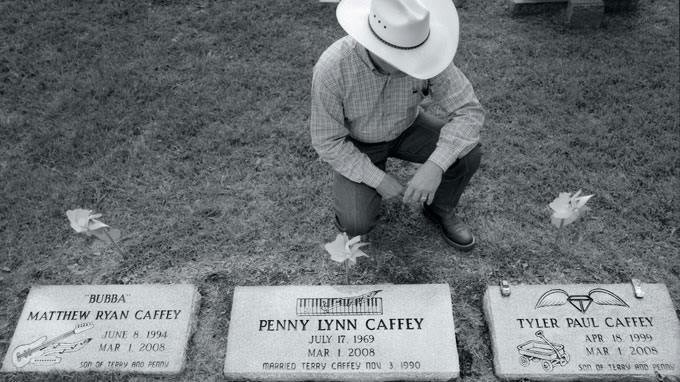
He asked prosecutors not to seek the death penalty. “My heart tells me there have been enough deaths,” he wrote. Charlie Wilkinson and Charles Waid pleaded guilty and got life without parole. Bobbi Johnson got 40 years. At Charlie’s sentencing, Terry stood up in court and told him he forgave him. “I refuse to grow into a bitter old man,” he said.
On January 2, 2009, Erin Caffey, 17, accepted a plea deal: two life sentences and 25 more years. She could be eligible for parole when she is 59. Her father stood beside her and held her hand.
Terry Caffey became an ordained minister. He remarried. He has told his story in hundreds of churches and schools. He has kept visiting the daughter who, according to everyone else who was in that car, wanted him dead, and he has said that he forgives her.
He knows what the phone records say. He told a reporter once that he knew his daughter, and that she cried when he ran over a squirrel.